A Fiber Splicing Partner Built for Mission-Critical Data Centers
Choosing a Fiber Splicing Partner for Mission-Critical Data Centers
Despite record investment in AI and cloud infrastructure, the data center industry is facing a growing execution gap. Recent reporting shows that while billions of dollars are being deployed toward new capacity, the ability to deliver projects on schedule is slipping. In fact, more than 60% of planned U.S. data center capacity for 2027 is not yet under construction, with additional projects already delayed.
The reasons are many, ranging from power availability and permitting challenges to supply chain constraints. But the outcome is simple: timelines are tightening, and execution risk is increasing across every project. Large-scale data center programs are increasingly impacted by systemic constraints including power interconnection timelines, equipment lead times, and workforce availability with ripples felt across every site. In this high-stakes build environment, fiber optic splicing is a lever for schedule control, risk reduction, and long-term network performance.
How Is Fiber Splicing Crucial to Hyperscale Data Center Performance?
Fiber optic networks are the backbone of data center connectivity, enabling high‑bandwidth, low‑latency data transmission that powers cloud, AI, and enterprise applications. Fiber splicing and testing play a fundamental role in building continuous optical pathways that ensure signal integrity, minimize loss, and maintain consistent performance across thousands of connections.
In hyperscale environments, the scale means the impact of splicing operations is immense:
- Tens of thousands of fiber terminations per site
- High‑density optical distribution frames (ODFs)
- Tight loss budgets across long-distance interconnections
When new buildouts are falling behind schedule, the margin for error in downstream activities shrinks. Fiber splicing and termination—already on the critical path—become even more consequential. Any inconsistency, rework, or resource gap at this stage can compound broader project delays, slowing testing, commissioning, and time-to-revenue.
Building Scalable Connectivity Across Every Location
As hyperscale cloud and AI demand continue to grow, data center operators are developing entire campuses and multi‑site ecosystems that each must provide consistent performance regardless of geography or build timeline.
Delivering fiber infrastructure across a single data center is complicated and executing it across multiple sites, often simultaneously, introduces next-level complexity. At the center of this challenge is precision execution of fiber optic splicing and termination. For data center operators seeking consistency across multi‑site fiber projects, experienced fiber optic splicing contractors are essential to ensure:
1. Consistency Across Markets
Multi-site builds require standardized processes and outcomes across different locales. Downstream issues caused by variations in splicing quality or documentation can compound when replicated across multiple buildings or sites.
2. Schedule Coordination
Installation efficiency has become a measurable advantage and fiber splicing is integral to on-time delivery of planned builds. Proven mass fusion splicing techniques can reduce splice cycles and accelerate hyperscale deployment timelines.
3. Logistics and Workforce Scaling
Even when power or permitting is the headline constraint, large-scale fiber splicing requires coordinated deployment of skilled technicians, equipment, and materials across multiple job sites to maintain build schedules. Poorly organized workflows or labor gaps create further bottlenecks.
4. Environmental and Field Conditions
From controlled white space environments to outside plant (OSP) installations, splicing teams must maintain precision despite the risk of contamination, alignment errors, or inconsistent processes.
5. Documentation and Testing Alignment
- Accurate fiber documentation, loss testing, and validation must align across all sites to meet owner/operator acceptance standards and support long‑term maintenance.
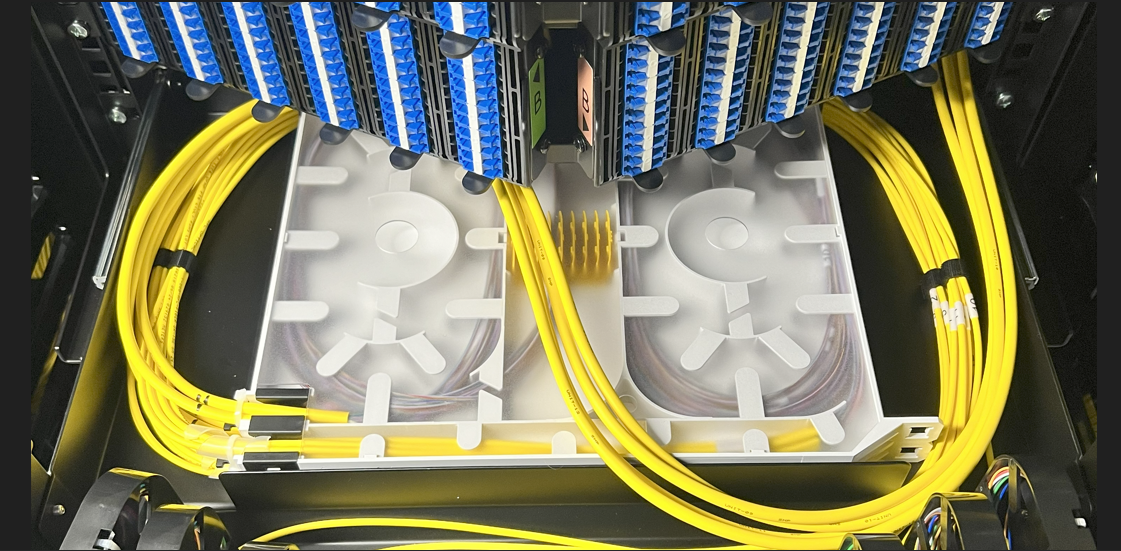
Why Do Professional Fiber Optic Splicing Contractors Matter?
To overcome these challenges, data center operators are increasingly turning to specialized splicing vendors who can deliver consistency at scale through:
- Precision execution and documented best practices aligned across crews in multiple locations
- Integration with construction workflows to avoid project delays
- Comprehensive testing and documentation for commissioning and long-term support
- Clean, organized routing and labeling practices that support daily operations and periodic audits
- Proven workforce scaling practices ensuring that a right-sized crew is on every site to meet project schedules
High-quality splicing and termination directly impacts network reliability, uptime, and future scalability, making contractor expertise a critical factor in project success.
A Turnkey Approach to Fiber Splicing and Termination
As one of the first contractors in the U.S. to deploy advanced ribbon and ultra‑high‑count fiber cables, NTI brings unmatched technical expertise to complex, high‑density, and multi-site environments. Today, that long history translates into millions of completed splices and a reputation among customers and manufacturers as a go‑to partner. Our approach is built on four pillars:
1. Expertise in High-Density and High-Count Fiber Environments
From mass fusion splicing to complex ribbon fiber architectures, NTI teams are equipped to handle the specialized demands of hyperscale data halls, meet-me rooms, and inter-campus connectivity. With significantly lower insertion loss than connectors, fusion splicing is the preferred approach in high‑density data center builds and NTI teams have specialized in this area for almost two decades.
2. Scalable Workforce for Multi-Site Execution
With a nationwide footprint and deep bench of trained splicing technicians, NTI supports concurrent builds across multiple markets to keep schedules aligned and eliminate bottlenecks. While workforce has been a constraint in the industry, we’ve successfully onboarded hundreds of new techs in 2026 to meet booming demand and continue to refine workforce management processes in order to effectively staff large-scale buildouts.
3. Integrated Testing and Validation
NTI integrates end‑to‑end fiber testing directly into splicing workflows, ensuring that every connection meets performance thresholds before handoff and minimizing downstream rework.
4. Consistent Processes and Documentation
Standardized execution across all sites ensures repeatable quality, simplifies acceptance, and reduces long-term operational risk. Detailed documentation supports periodic audits and speeds future troubleshooting and repairs. This strategy ensures that fiber splicing is never the bottleneck but instead is a driver of on‑time delivery.
Future-Proofing Multi-Site Data Center Fiber Networks
As AI and cloud demand accelerates, fiber density and connectivity requirements will continue to increase dramatically. Industry research indicates that supporting AI-driven data center growth will require significant expansion in fiber infrastructure and interconnections. This makes early decisions around splicing quality, documentation, and vendor selection even more crucial. Partnering with an experienced, scalable fiber optic splicing contractor can help operators:
- Maintain consistent build quality across every site
- Reduce risk during deployment and daily operations
- Enable faster, more efficient expansion
- Protect long-term network performance
The operators who bring infrastructure online fast and reliably will be those who aligned with partners capable of delivering consistent results across every site, every phase, and every connection.
NTI combines nationwide workforce depth, advanced fiber splicing expertise, and integrated testing capabilities to maintain schedule certainty, deliver consistent quality across geographies, and integrate seamlessly into complex build programs. Get in touch if we can help support your growth.
Get in touch with our team to talk about your next project.
